
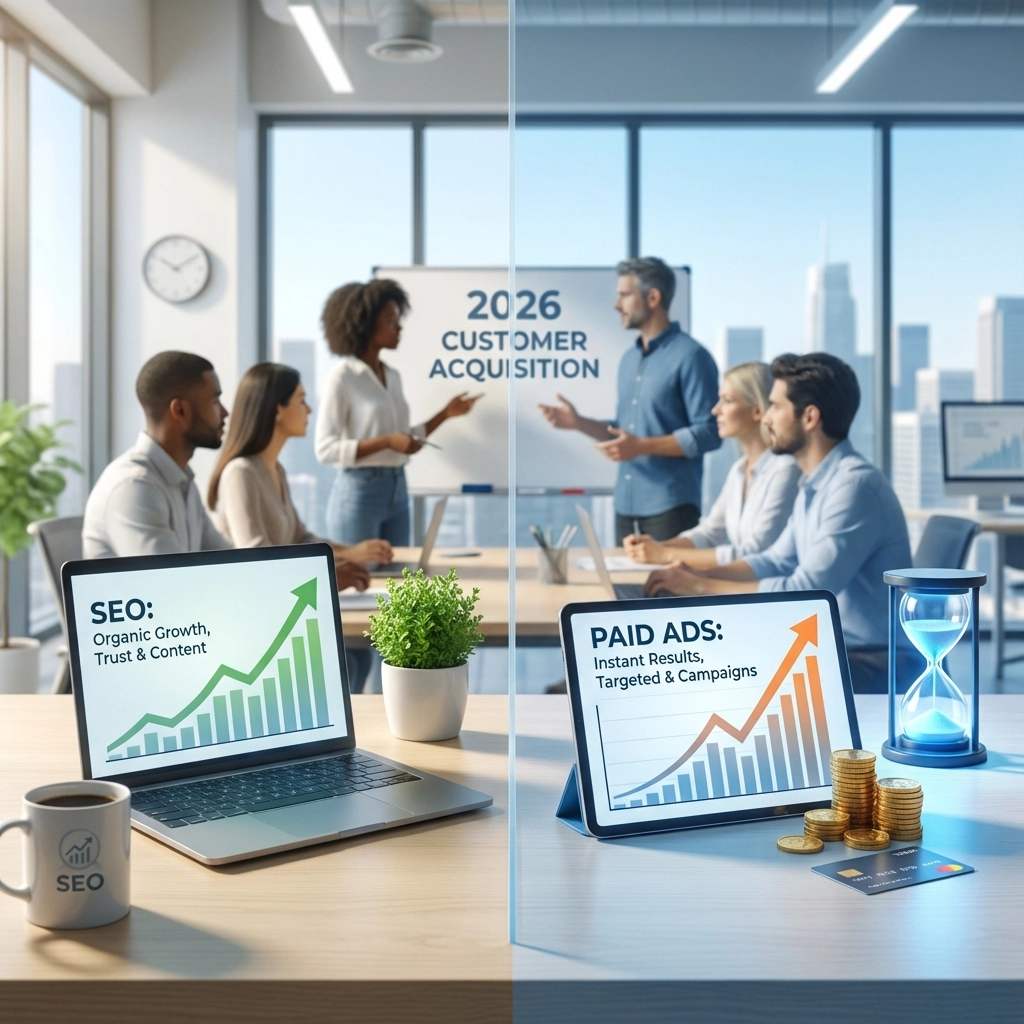
Your startup needs customers yesterday. But which path gets you there faster: SEO or paid ads? The answer isn’t what most founders expect.
After analyzing data from hundreds of startups, the truth is clear. The best choice depends entirely on your cash runway and timeline needs. However, the long-term winner delivers 748% ROI while the quick fix caps out at 200%.
Let’s break down the real numbers behind the SEO vs paid ads debate for 2026.
The Speed vs Sustainability Trade-Off
Paid advertising delivers leads within 1-7 days. Google Ads can drive traffic to your startup’s website the moment your campaign goes live. Facebook ads can generate brand awareness overnight.
Meanwhile, SEO typically requires 3-6 months before meaningful organic traffic appears. Your content needs time to rank, build authority, and attract backlinks.
This creates a fundamental question: Do you need customers this month or customers for years to come?

The ROI Reality Check
The numbers tell a compelling story. SEO delivers an average 748% return on investment compared to 200% for paid advertising, according to industry research from Search Engine Land.
However, these ROI timelines work differently. Paid ad ROI is measured monthly and remains relatively flat. You spend $1,000, you get leads worth $2,000, then you spend another $1,000 next month.
SEO ROI compounds over 24-36 months. Your initial content investment continues generating leads indefinitely after publication. Therefore, a blog post written today might still drive qualified prospects three years from now.
Consider this real case study: A SaaS startup spent $15,000 monthly on Google Ads, generating 150 qualified leads at $100 each. After redirecting $10,000 toward programmatic SEO content, month one was painful with only 10 leads. However, by month six, those SEO pages generated 200 leads monthly while paid spend dropped to $8,000.
Customer Quality Makes the Difference
Not all customers are equal. SEO visitors typically convert into higher-lifetime-value customers than paid traffic visitors.
Organic search traffic delivers 15-30% higher customer lifetime value (CLV) than paid traffic. Why? People conducting research tend to be more informed buyers with realistic expectations and lower churn rates.
When someone finds your startup through a blog post about “how to choose the right e-commerce platform,” they’re already educated about your solution. In contrast, someone clicking a Facebook ad might be in early discovery mode.
Moreover, organic traffic suggests genuine interest rather than impulse clicking. These prospects often spend more time on your site, read multiple pages, and make more informed purchasing decisions.

Budget Reality for Bootstrapped Startups
Cash flow constraints force most startups to choose one strategy initially. Furthermore, the decision often comes down to survival math rather than optimal marketing theory.
If your startup has less than six months of runway, paid ads become your only viable option. You simply cannot wait for SEO to deliver results when payroll is due next month.
However, if you have adequate runway, allocating 60-70% of your marketing budget toward SEO content creation will eventually deliver more customers per dollar spent.
The key is understanding your break-even timeline. Paid ads hit break-even within weeks but plateau quickly. SEO takes 8-18 months to break even but continues climbing for years.
When Paid Ads Win the SEO vs Paid Ads Battle
Certain scenarios favor paid advertising over organic search strategies:
Immediate Revenue Needs: If your startup requires cash flow within 30 days, paid ads are your only realistic option.
Seasonal Opportunities: Holiday shopping, tax season, or industry-specific peak periods demand immediate visibility that SEO cannot provide.
Product Launches: New product announcements need immediate market penetration to build momentum and gather feedback.
Competitive Markets: In highly competitive industries, paid ads can help you compete against established players while your SEO strategy develops.
Testing Market Fit: Paid campaigns allow rapid testing of messaging, audiences, and value propositions before committing to long-term SEO content strategies.

When SEO Dominates Long-Term Growth
SEO becomes the superior choice in specific startup situations:
Sustainable Growth Models: If your business model depends on predictable, scalable customer acquisition, SEO provides the foundation for sustainable growth.
Educational Content Opportunities: Startups solving complex problems benefit from educational content that builds trust and demonstrates expertise over time.
B2B Sales Cycles: Longer sales cycles align perfectly with SEO timelines, as prospects research solutions for weeks or months before purchasing.
Limited Ongoing Budget: Once published, SEO content continues working without additional investment, making it ideal for bootstrapped operations.
Brand Building: Organic search results build credibility and brand authority that paid ads cannot match.
The Hybrid Approach That Actually Works
The most successful startups in 2026 don’t choose between SEO vs paid ads: they integrate both strategically.
Start with a small paid advertising budget to generate immediate leads and cash flow. Use this revenue to fund content creation and SEO efforts. As your organic rankings improve, gradually shift budget allocation toward content while maintaining paid campaigns for high-intent keywords.
This approach provides immediate results while building long-term sustainable growth. Additionally, data from paid campaigns reveals which keywords and messaging resonate with your audience, informing your SEO content strategy.
Many successful startups allocate their marketing budgets using the 70-20-10 rule: 70% toward proven channels (initially paid ads, later SEO), 20% toward growing channels, and 10% toward experimental tactics.

How Airbow Approaches SEO vs Paid Ads for Startups
At Airbow, we’ve helped dozens of startups navigate the SEO vs paid ads decision. Our SEO & Digital Marketing services focus on building integrated strategies that deliver both immediate and long-term results.
We typically recommend starting with targeted paid campaigns to generate initial traction and revenue. Simultaneously, we develop comprehensive SEO strategies that build authority and organic visibility over time.
Our approach includes:
- Immediate Impact: Strategic paid campaigns targeting high-intent keywords
- Content Foundation: Educational blog content that attracts and nurtures prospects
- Technical SEO: Website optimization for search engines and user experience
- Performance Tracking: Detailed analytics to optimize both paid and organic efforts
The result is a marketing system that generates customers today while building sustainable growth for tomorrow. the full page
Making the Right Choice for Your Startup
The SEO vs paid ads decision ultimately depends on three factors: your cash runway, customer acquisition timeline, and long-term growth goals.
Choose paid ads if you need customers within 30 days, have limited runway, or operate in highly seasonal markets. Select SEO if you can invest in 6-12 month timelines, want sustainable growth, or target educational content opportunities.
However, the most successful approach combines both strategies strategically. Use paid ads to generate immediate cash flow and fund SEO investments that deliver compounding returns over time.
Remember, this isn’t a permanent decision. You can start with paid advertising and gradually shift toward SEO as your organic presence grows. The key is matching your strategy to your current business needs while building toward long-term sustainability.

Ready to develop a marketing strategy that delivers both immediate results and sustainable growth? Discover how Airbow’s integrated approach to SEO and digital marketing can help your startup acquire more customers in 2026.

